TE Series Digital Stepper Driver For Nema 34 Motors, 2.4-7.2A, 20 To 80VAC And 30 To 100VDC, High Efficiency Motion Controller, Beast Mode Performance, Solid Upgrade With Smooth Precision
TE Series Digital Stepper Driver For Nema 34 Motors, 2.4-7.2A, 20 To 80VAC And 30 To 100VDC, High Efficiency Motion Controller, Beast Mode Performance, Solid Upgrade With Smooth Precision
Original: $66.79
-65%$66.79
$23.38The Story
✔️ 2.4-7.2A peak current, 20-80VAC/30-100VDC input
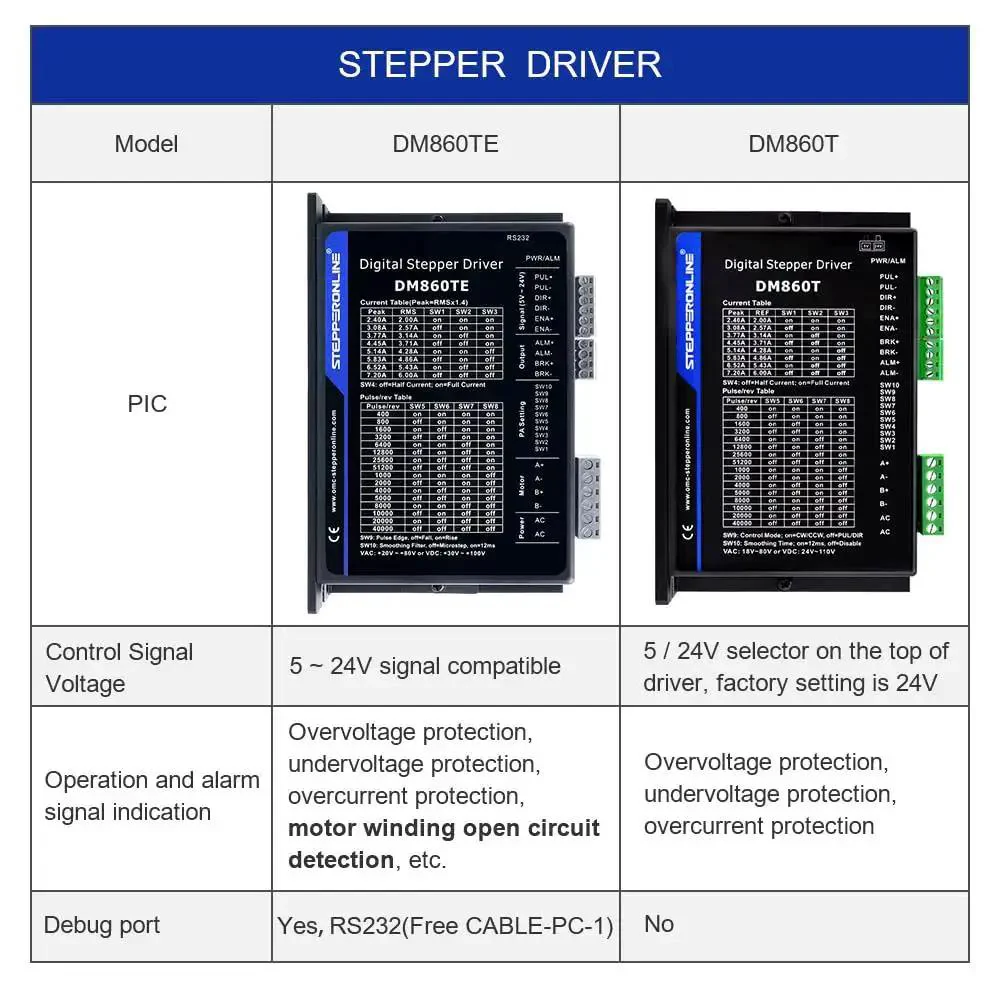
The TE Series digital stepper driver is a compact, cost‑effective motion controller designed for Nema 34 motors, delivering precise microstepping and built‑in protection. It’s ideal for CNC, automation, and robotics setups that need smooth motion and reliable performance. Includes 1 x TE Series driver and RS232 cable.
✅ Peak Output Current: 2.4-7.2A (2.0-6.0 RMS)✅ Input Voltage: +20-80VAC / 30-100VDC
✅ Logic Input: 5-24VDC, 7-20mA
✅ Pulse Input: up to 200kHz, 2.5µs width, TTL compatible
✅ Optically Isolated Inputs 5-24V
✅ PUL/DIR and CW/CCW modes
✅ Motor Winding Open Circuit Detection
✅ Automatic Idle-Current Reduction
✅ Soft-start with no jump on power-up
✅ Anti-Resonance for stable torque
✅ 8 selectable peak currents: 2.4-7.2A
✅ 16 selectable microstep resolutions up to 40000
✅ Supports 2‑phase and 4‑phase motors
✅ Over-voltage / Over-current protection
✅ Pulse Input Frequency 0-200kHz
✅ Cooling: Natural or Forced
✅ Operating Temp 0-40°C; Storage -20-65°C
💡 What is a digital stepper driver used for in CNC and automation?
It translates control signals into precise motor motion and adds built‑in protection and configuration options for different motors.
- Converts control signals into accurate stepping and torque control
- Provides microstepping for smooth movement and precise positioning
- Includes fault protection like over-current and open-circuit detection
- Offers optically isolated TTL inputs to ease system integration

Details & Craftsmanship
Every detail has been carefully considered to bring you the perfect product.

Details & Craftsmanship
Every detail has been carefully considered to bring you the perfect product.

Details & Craftsmanship
Every detail has been carefully considered to bring you the perfect product.

Details & Craftsmanship
Every detail has been carefully considered to bring you the perfect product.

Details & Craftsmanship
Every detail has been carefully considered to bring you the perfect product.

Details & Craftsmanship
Every detail has been carefully considered to bring you the perfect product.
Details & Craftsmanship
Every detail has been carefully considered to bring you the perfect product.
Description
✔️ 2.4-7.2A peak current, 20-80VAC/30-100VDC input
The TE Series digital stepper driver is a compact, cost‑effective motion controller designed for Nema 34 motors, delivering precise microstepping and built‑in protection. It’s ideal for CNC, automation, and robotics setups that need smooth motion and reliable performance. Includes 1 x TE Series driver and RS232 cable.
✅ Peak Output Current: 2.4-7.2A (2.0-6.0 RMS)✅ Input Voltage: +20-80VAC / 30-100VDC
✅ Logic Input: 5-24VDC, 7-20mA
✅ Pulse Input: up to 200kHz, 2.5µs width, TTL compatible
✅ Optically Isolated Inputs 5-24V
✅ PUL/DIR and CW/CCW modes
✅ Motor Winding Open Circuit Detection
✅ Automatic Idle-Current Reduction
✅ Soft-start with no jump on power-up
✅ Anti-Resonance for stable torque
✅ 8 selectable peak currents: 2.4-7.2A
✅ 16 selectable microstep resolutions up to 40000
✅ Supports 2‑phase and 4‑phase motors
✅ Over-voltage / Over-current protection
✅ Pulse Input Frequency 0-200kHz
✅ Cooling: Natural or Forced
✅ Operating Temp 0-40°C; Storage -20-65°C
💡 What is a digital stepper driver used for in CNC and automation?
It translates control signals into precise motor motion and adds built‑in protection and configuration options for different motors.
- Converts control signals into accurate stepping and torque control
- Provides microstepping for smooth movement and precise positioning
- Includes fault protection like over-current and open-circuit detection
- Offers optically isolated TTL inputs to ease system integration